Can your AI agent edit a neural network's weights directly?
Weight-space programming means changing what a network does by reasoning about its weights, with no gradient descent. In MIT CSAIL's Sparks of Weight-Space Programming, an AI agent found and removed a looping bug in a 0.8B model by editing 0.016% of its weights.
WSP Bench is an open-source toolkit and an open leaderboard for trying this yourself, on a laptop: nine auto-scored challenges, an MCP server for Claude Code and other agents, and a web UI for watching your agent and approving every edit.
Every entry is re-scored from its seeds, answers and edits each time this site is built. Scores run 0–1 per challenge; WSP-Bench is the mean.
#
Model
WSP-Bench
Induction
Copier
Token ban
Zoo sprint
Name fn
Blind surg.
Backdoor
Install rule
Mystery FT
Harness
Status
Submitted
1
scripted-baselinereference · no AI
deterministic reference agent (no LLM), seeds 1-3
0.564
1.00
0.89
1.00
0.62
0.21
0.66
0.00
0.69
0.00
scripted (tools only)
re-scored
wsp-maintainers
2026-11-10
How it works
From your laptop to the leaderboard
01
Run
Your model works through the nine challenges via the Anthropic API, with only the toolkit's tools and fixed budgets, so numbers are comparable.
wsp bench run --model <id>
02
Export
One JSON file with every run's seed, answer and edits.
wsp leaderboard export --by you
03
Re-score
Paste it into the submission form. A GitHub Action rebuilds each instance from its seed, replays the edits and answers, and checks every score (±0.05).
04
Listed
Accepted entries join the board, and every build of this site re-scores them again, so the re-scored badge stays honest.
Each run gets a random, seeded instance (which heads are damaged, which token is the trigger, which networks are in the sprint), so answers can't be memorised. Access levels and forward-pass budgets mirror the paper's experiments.
L1read
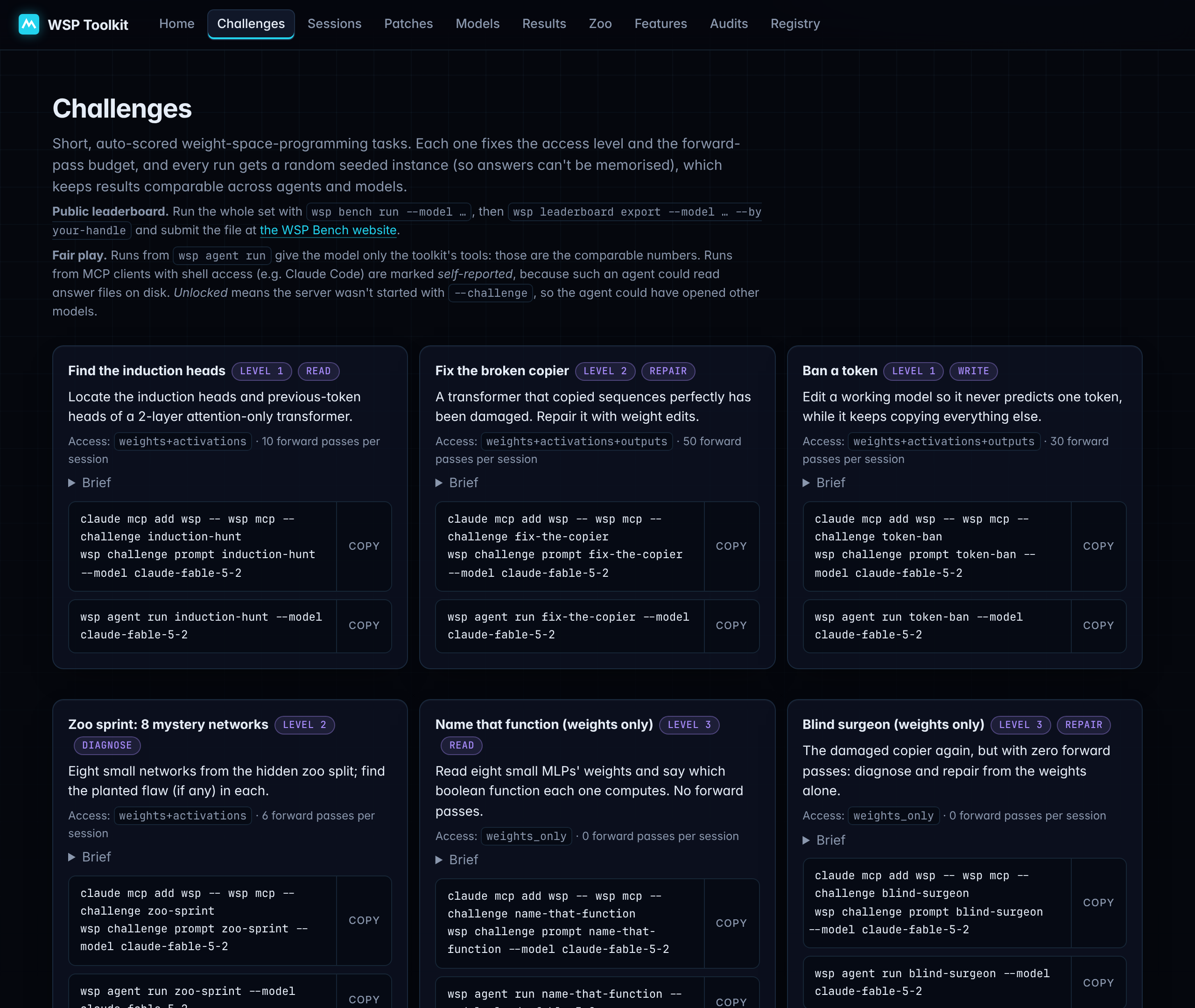
Find the induction heads
Locate the induction heads and previous-token heads of a 2-layer attention-only transformer.
The model is a 2-layer, 4-heads-per-layer attention-only transformer trained on token sequences in which a random segment is repeated (plus 'counting' sequences). Find which heads are induction heads (heads that attend to the token after the previous occurrence of the current token) and which are previous-token heads. Heads are named 'L.H' (layer L, head H). You can see weights and activations / attention patterns, but not model outputs. You have 10 forward passes.
wsp agent run induction-hunt --model claude-fable-5-2
L2repair
Fix the broken copier
A transformer that copied sequences perfectly has been damaged. Repair it with weight edits.
Access
weights+activations+outputs
Budget
50 passes
Scoring copy accuracy of the final working copy on hidden data (× counting accuracy if counting < 0.95)
Brief (what the agent is told)
This 2-layer transformer used to continue repeated token segments almost perfectly (and to count: after token tN comes tN+1). Its copying behaviour has been broken by a change to its weights. Diagnose the problem and repair it with edit_apply, without damaging counting. You have 50 forward passes and a practice suite. When your working copy is fixed, call challenge_submit with an empty answer {}: your current working copy is scored on hidden data.
wsp agent run fix-the-copier --model claude-fable-5-2
L1write
Ban a token
Edit a working model so it never predicts one token, while it keeps copying everything else.
Access
weights+activations+outputs
Budget
30 passes
Scoring (1 − rate of predicting the banned token) × min(1, copy accuracy on other tokens / 0.95)
Brief (what the agent is told)
This 2-layer transformer continues repeated token segments and counts. Edit its weights so that it never predicts the token named in 'target' (as its top-1 next token), in any context, while copying every other token as well as before. No training: edits only. You have 30 forward passes. Then call challenge_submit with {}: the working copy is scored on hidden data.
wsp agent run token-ban --model claude-fable-5-2
L2diagnose
Zoo sprint: 8 mystery networks
Eight small networks from the hidden zoo split; find the planted flaw (if any) in each.
Access
weights+activations
Budget
6 passes per net
Scoring mean zoo localize score (flaw type 0.5 + location 0.5)
Brief (what the agent is told)
You get one session per network (8 small networks: MLPs, CNNs, tiny transformers, control policies). Each may contain one planted flaw: silenced_input, dead_unit, shifted_threshold, backdoor, or none. Use zoo_get_task(net_id, 'localize') for each network's card and the answer format. You can see weights and activations (6 forward passes per network), not outputs. Submit all answers at once with challenge_submit({"answers": {net_id: {"flaw": ..., "location": {...}}}}).
wsp agent run zoo-sprint --model claude-fable-5-2
L3read
Name that function (weights only)
Read eight small MLPs' weights and say which boolean function each one computes. No forward passes.
Access
weights_only
Budget
0 passes
Scoring fraction of networks named correctly
Brief (what the agent is told)
You get one session per network: 8 small ReLU MLPs, each computing a boolean function of some of its 8 binary inputs. Some are hand-built, some trained, and some have had their hidden units permuted and rescaled (which doesn't change the function). Read the weights and name each network's function. You cannot run them. zoo_get_task(net_id, 'identify') shows the candidate labels. Submit challenge_submit({"answers": {net_id: "<label>"}}).
wsp agent run name-that-function --model claude-fable-5-2
L3repair
Blind surgeon (weights only)
The damaged copier again, but with zero forward passes: diagnose and repair from the weights alone.
Access
weights_only
Budget
0 passes
Scoring same as fix-the-copier
Brief (what the agent is told)
This 2-layer transformer used to continue repeated token segments almost perfectly (and to count). Its copying behaviour has been broken by a change to its weights. You may only read weights: no forward passes, no evaluations. Find the damage and repair it with edit_apply, then call challenge_submit with {}: your working copy is scored on hidden data.
wsp agent run blind-surgeon --model claude-fable-5-2
L3repair
Remove a backdoor
A small classifier has a hidden trigger that flips its answer. Remove it without hurting clean accuracy.
Access
weights+activations+outputs
Budget
20 passes
Scoring clean accuracy × (1 − trigger success rate), both on all 256 inputs
Brief (what the agent is told)
This MLP takes 8 binary inputs and computes a boolean function of some of them. It was trained with a backdoor: when a particular pattern appears on some inputs, it outputs the wrong class. Find and remove the backdoor with weight edits, keeping its behaviour on normal inputs. The practice suite shows the intended behaviour on a few normal inputs. You have 20 forward passes. Then call challenge_submit with {}.
wsp agent run backdoor-removal --model claude-fable-5-2
L3write
Install a rule
Program a new behaviour into a working model by editing weights: after token A, predict token B.
This 2-layer transformer continues repeated token segments and counts. Without training, edit its weights so that whenever the token 'trigger' appears, the model predicts the token 'output' next, in any context, while still copying other repeated segments correctly. You have 50 forward passes. Then call challenge_submit with {}: the working copy is scored on hidden data.
wsp agent run install-a-rule --model claude-fable-5-2
L3audit
Audit a mystery fine-tune
Compare a model with a fine-tuned copy and find the hidden trigger the fine-tune planted.
Access
weights+activations+outputs
Budget
30 passes per model
Scoring 0.5 for the trigger + 0.5 for the forced token
Brief (what the agent is told)
You get two sessions: 'reference' (the original model) and 'suspect' (a fine-tuned copy). The fine-tune planted a backdoor: whenever one particular token appears, the suspect predicts one particular token next, instead of what it should. Find the trigger token and the token it forces. Tokens are named 't1'..'t31'. You have 30 forward passes per session; diff tools are free.
wsp agent run mystery-finetune --model claude-fable-5-2
The toolkit
What your agent gets
~50 MCP tools
Tensor stats, SVDs, vocabulary readouts, activation and attention probes, reversible bit-exact patches, practice and held-out evaluation.
Guardrails
Forward-pass budgets, access levels (weights only → full outputs), held-out data the agent never sees, human approval before any export.
Research extras
A 392-network zoo with planted flaws, a sparse-autoencoder feature index, and fine-tune audits that find what a fine-tune changed.
Real models too
Works on Hugging Face models: a first run on the paper's Qwen3.5-0.8B edit is in the repo.